| Cleanroom Classification | Commonly used in ISO Class 5 to ISO Class 8 controlled areas, depending on the room process and contamination-control plan. | The door must support the required air cleanliness level without creating unnecessary particle release or turbulence. | Flush, low-particle doors with sealed frames, smooth surfaces, and minimal exposed hardware. |
| Opening Width | Typical single-leaf clear width: approximately 800–1,200 mm. Wider openings may require a double-leaf arrangement. | The opening should accommodate personnel, carts, pallets, or production equipment without causing traffic delays. | Single swing door for personnel traffic; double swing door for carts, material handling, or emergency egress requirements. |
| Opening Height | Typical clear height: approximately 2,000–2,400 mm, subject to equipment and building constraints. | Adequate height prevents contact with carts and improves the movement of tall loads through the controlled area. | Standard-height single door for personnel; increased-height or double-leaf door for equipment and material transfer. |
| Traffic Frequency | Low to moderate traffic is generally suitable for manual operation. High-frequency traffic benefits from assisted or automatic operation. | Frequent manual opening can increase pressure fluctuation, operator fatigue, and the time that the doorway remains open. | Self-closing manual door for occasional use; automatic or power-assisted swing door for frequent traffic. |
| Pressure Differential | Many facilities use a positive pressure differential of approximately 5–15 Pa between adjacent rooms, but the project design determines the final value. | Door seals, closing force, and interlocking strategy must work with the room pressure cascade. | Perimeter-gasketed door with reliable self-closing hardware; interlocked doors where pressure control requires it. |
| Surface Cleanability | Use smooth, non-porous, corrosion-resistant surfaces with sealed joints and limited ledges. | Simpler geometries reduce particle traps and make routine cleaning and disinfection more consistent. | Flush door leaf, radiused or sealed edges, concealed fasteners where practical, and cleanable vision panels. |
| Material Selection | Common choices include coated steel, stainless steel, and high-pressure laminate or composite panels selected for the cleaning chemicals used onsite. | The door material must resist corrosion, staining, impact, and repeated exposure to approved detergents and disinfectants. | Stainless steel for demanding or corrosive environments; coated or composite construction for less aggressive conditions. |
| Door Leaf Construction | Use rigid, sealed, insulated construction when temperature stability, durability, or sound control is required. | A stable leaf reduces warping, protects the perimeter seal, and supports consistent closing performance over time. | Hollow or honeycomb-core construction for standard use; insulated core for temperature-controlled or higher-duty areas. |
| Air Leakage Control | Specify continuous perimeter seals, an accurately fitted frame, and a controlled closing sequence. The leakage target should be defined by the project specification. | Uncontrolled leakage can disrupt room pressure relationships and increase the burden on the HVAC system. | Gasketed swing door with adjustable hinges, positive latching, and verified installation tolerances. |
| Interlocking Requirement | Use a door interlock or airlock arrangement where simultaneous opening could compromise segregation or pressure control. | Interlocks help prevent direct airflow paths between spaces with different cleanliness or pressure requirements. | Single or double swing doors integrated with an electrical or mechanical interlock system. |
| Safety and Egress | Emergency release, opening direction, clear width, hardware, and fire performance must comply with applicable local building and life-safety codes. | Cleanroom performance cannot override emergency evacuation requirements. | Outward-opening or code-compliant egress door where required; panic or emergency-release hardware when specified by the authority having jurisdiction. |
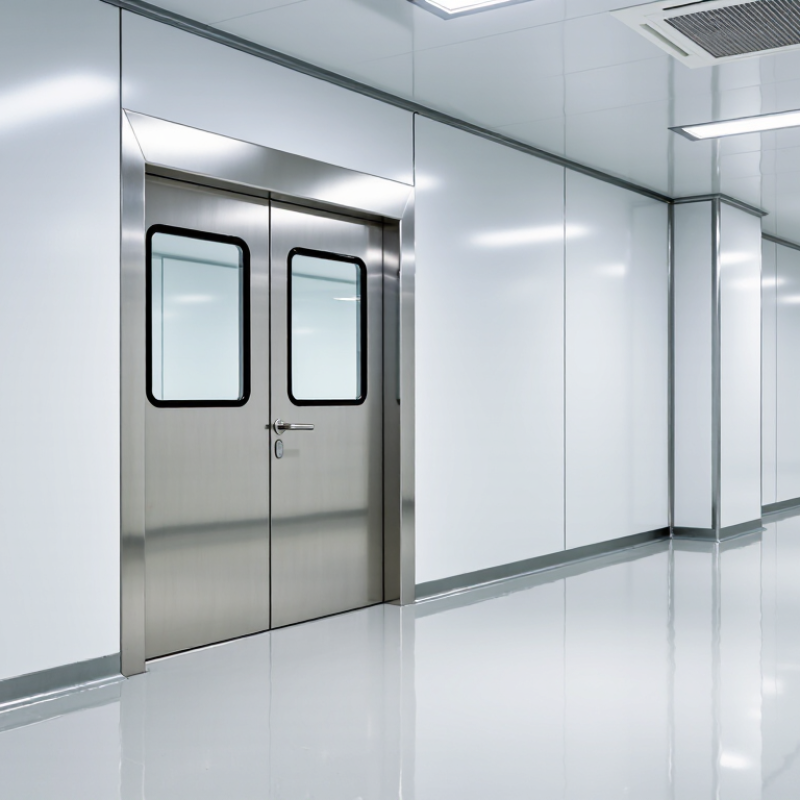
| Vision Panel | Use a flush, sealed, impact-resistant vision panel when visibility is needed for personnel safety or workflow control. | Visibility can reduce collisions and unnecessary door openings while supporting safer material and personnel movement. | Double-glazed or sealed flush vision panel with rounded or protected edges. |
| Cleaning and Disinfection | Confirm compatibility with the facility’s actual cleaning agents, contact times, concentration levels, and cleaning frequency. | A material that tolerates routine cleaning helps maintain hygiene performance and lowers replacement risk. | Non-porous, chemical-resistant finishes with sealed joints and hardware designed for wet or frequent cleaning. |
| Durability and Impact Exposure | Assess trolley frequency, impact locations, door-cycle volume, and the need for kick plates or protective guards. | Impact-resistant construction reduces dents, alignment problems, and seal damage caused by carts or equipment. | Reinforced door leaf, protected lower section, heavy-duty hinges, and replaceable impact plates where necessary. |
| Maintenance Access | Choose adjustable hinges, replaceable seals, accessible closers, and readily available spare components. | Simple maintenance helps preserve closing speed, sealing performance, and compliance throughout the door’s service life. | Modular hardware and replaceable perimeter gaskets with documented inspection intervals. |
| Automation and Controls | Consider sensors, push plates, access control, status indicators, and building-management-system interfaces where operationally necessary. | Automation can reduce touch points and shorten open time, but it adds controls, commissioning, and maintenance requirements. | Low-energy automatic swing door for controlled traffic; hands-free activation for hygiene-sensitive workflows. |
| Recommended Selection Approach | Define the room classification, pressure cascade, traffic pattern, opening size, cleaning regime, safety codes, and lifecycle requirements before final specification. | A door that matches the process and room system performs more reliably than a door selected by appearance or initial price alone. | Select the simplest compliant swing door system that meets contamination control, safety, durability, and workflow needs. |



 © Copyright 2020 Tianjin Tanghaidongyang Valve Co., Ltd. All Rights Reserved.