| Operating Principle | An NTC thermistor has a negative temperature coefficient: its electrical resistance decreases as temperature increases. | The resistance change can be measured with a simple voltage-divider or bridge circuit. | The resistance-temperature curve is nonlinear, so the controller may require calibration, a lookup table, or mathematical linearization. |
| Temperature Sensitivity | NTC resistance changes substantially over a relatively small temperature interval. A common nominal resistance is 10 kΩ at 25°C, although many other resistance values are available. | High sensitivity can support effective temperature detection and control near a specified operating point. | Nominal resistance and beta value vary by sensor design; values must match the electronics and required temperature range. |
| Measurement Range | Many encapsulated NTC probes are designed for ranges such as approximately −50°C to 150°C, while the actual range depends on the thermistor material, insulation, housing, and lead construction. | The range is suitable for many HVAC, appliance, battery, medical, and process-monitoring applications. | The probe must be selected according to the maximum temperature, thermal cycling, chemical exposure, and mechanical conditions. |
| Accuracy Potential | Accuracy depends on resistance tolerance, beta-value tolerance, calibration, self-heating, installation, and signal-conditioning design. | A calibrated NTC system can provide good accuracy over a defined temperature span. | Accuracy is not determined by the thermistor alone; the complete probe, wiring, circuit, and software must be evaluated together. |
| Response Time | Small-bead or small-tip NTC sensors generally respond faster than larger probes because they have less thermal mass. | Fast response can improve control of rapidly changing temperatures. | Response time depends strongly on probe size, sheath material, mounting method, airflow, and the surrounding medium. |
| Circuit Integration | An NTC is a passive two-terminal component and does not require an external power supply at the sensing element. | It can be integrated with analog inputs, microcontrollers, thermostats, and battery-management electronics using relatively simple circuitry. | Measurement current should be controlled to limit self-heating, especially in low-temperature or high-accuracy applications. |
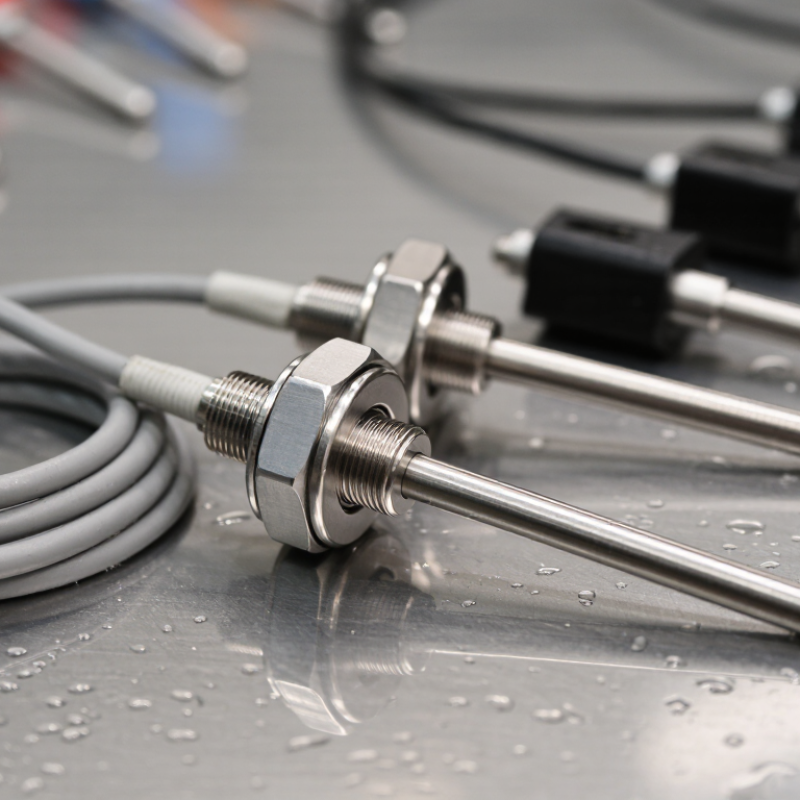
| Physical Flexibility | NTC sensing elements can be supplied in bead, disk, ring, surface-mount, sealed-tip, and stainless-steel probe constructions. | The probe can be adapted to surface sensing, immersion, air measurement, or confined installation spaces. | The encapsulation and cable jacket must be compatible with moisture, vibration, chemicals, pressure, and required ingress protection. |
| Size and Weight | The sensing element can be very compact, with the final probe size determined mainly by the protective housing and connection method. | Compact construction is useful for portable equipment, densely packed electronics, and embedded temperature monitoring. | A smaller probe may be more sensitive to handling damage and may require additional mechanical protection. |
| Cost Efficiency | NTC thermistors are generally made from ceramic or polymer semiconductor materials and use a simple passive construction. | The simple sensing element and uncomplicated interface can help reduce sensor and electronics costs in high-volume designs. | The lowest-cost option may not meet requirements for long-term stability, high-temperature operation, or harsh environments. |
| Typical Applications | Common uses include HVAC equipment, refrigerators, water heaters, battery packs, chargers, power supplies, automotive systems, and medical devices. | NTC probes are practical for monitoring and feedback control where the temperature range is defined and repeatable. | Critical applications require appropriate validation, fault detection, insulation, and compliance testing. |
| Comparison with RTDs and Thermocouples | NTC probes often provide higher sensitivity and simpler low-cost integration than many alternatives, but they typically offer less linearity and are not ideal for every high-temperature or wide-range application. | They are a practical choice when compact size, sensitivity, quick response, and economical electronics are priorities. | Choose an RTD or thermocouple instead when the design requires a wider temperature range, standardized linearity, very high temperature capability, or specific industrial interchangeability. |



 © Copyright 2020 Tianjin Tanghaidongyang Valve Co., Ltd. All Rights Reserved.