Why Choose Aluminium Framed Doors for Global Projects?
Why Choose Aluminium Framed Doors for Global Projects?
Global construction projects demand doors that balance strength, appearance, performance, and practical installation. Aluminium Framed Doors meet these needs across offices, hotels, hospitals, retail spaces, and residential developments. Their slim profiles allow more daylight into a room. Their durable metal frames also support large glass panels without creating a heavy visual effect.
Dr. Stephen Selkowitz, a respected building-envelope researcher and former leader at Lawrence Berkeley National Laboratory, offers a useful principle: “A high-performance opening is a system, not a product.” This idea matters on international projects. A door frame must work with the glass, seals, hardware, drainage, thermal breaks, and surrounding wall. Ignoring one detail can cause condensation, air leakage, or difficult operation later.
Aluminium also supports consistent manufacturing across different locations. Standardized profiles can simplify specification, fabrication, and replacement. Powder-coated or anodized finishes provide practical protection in demanding environments, including coastal areas. Yet aluminium is not automatically the perfect choice. Poor thermal design can reduce energy performance. Weak installation can undermine an excellent frame.
That is the uncomfortable part.
Project teams must review climate data, local standards, accessibility needs, security expectations, and maintenance plans before selection. Experienced suppliers can provide test evidence for air permeability, water resistance, wind pressure, and operating cycles. These documents build confidence, but site workmanship still matters. A well-designed Aluminium Framed Doors system performs best when engineering and installation receive equal attention.
What Are Aluminium Framed Doors?
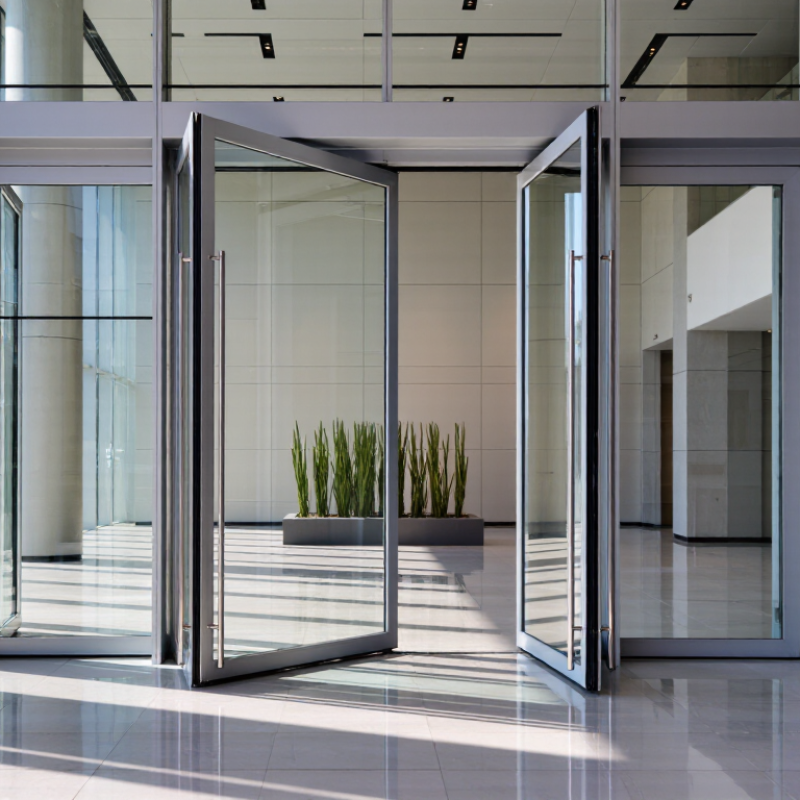
Aluminium framed doors are door systems built around lightweight, rigid aluminium profiles. The frame holds glass, insulated panels, hinges, locks, and weather seals in place. Unlike solid timber doors, they resist swelling, warping, and insect damage. This makes them practical for offices, apartments, schools, and public buildings in different climates.
Many modern profiles include thermal breaks. These insulating sections reduce heat transfer through the frame. Double or triple glazing can improve indoor comfort further. In coastal areas, suitable surface treatments and stainless-steel hardware help manage moisture and salt exposure. Field experience shows that installation quality matters as much as the frame itself. A strong door can still leak air if the threshold is poorly aligned. That detail is easy to miss.
For global projects, designers should check wind loads, drainage, accessibility, fire requirements, and local energy standards before selecting a system. Performance values should come from verified laboratory tests or documented project data. Aluminium is recyclable, but recycling outcomes depend on local collection systems. It is useful, not magically sustainable.
Tips: Confirm opening sizes on site. Review glass weight with the hardware supplier. Leave room for adjustment. Use installers familiar with aluminium systems. Test seals after installation, especially before the rainy season. Small errors become expensive later.
How Should They Be Selected and Maintained?
Choosing aluminium framed doors for a global project requires more than comparing prices. Selection should begin with the building’s climate, exposure, usage, and local regulations. Coastal sites need durable finishes and carefully protected hardware. Cold regions require thermally broken frames, insulated glass, and reliable weather seals. Measure twice. Small details matter.
Ask suppliers for tested air, water, wind, thermal, and acoustic performance. These figures should match the project’s design conditions, not only laboratory averages. Confirm frame dimensions, glass weight, threshold height, drainage paths, and emergency access with the project engineer. Local building codes must guide fire safety, accessibility, and safety glazing decisions. A full-size sample door can reveal problems drawings often hide.
Maintenance should be planned before installation. Remove dust and salt deposits with clean water and mild detergent, then dry the surfaces. Inspect gaskets, hinges, locks, screws, and drainage openings at least twice yearly. Do not guess. Replace damaged seals early, because small leaks can stain finishes and damage nearby materials. Avoid abrasive pads, strong acids, and unapproved cleaners. Keep a simple inspection record with dates and photographs. A perfect schedule rarely survives real construction conditions, so adjust it after observing weather, traffic, and user behavior. Even well-selected doors can underperform when installers rush, drainage is blocked, or maintenance responsibility remains unclear.



 © Copyright 2020 Tianjin Tanghaidongyang Valve Co., Ltd. All Rights Reserved.