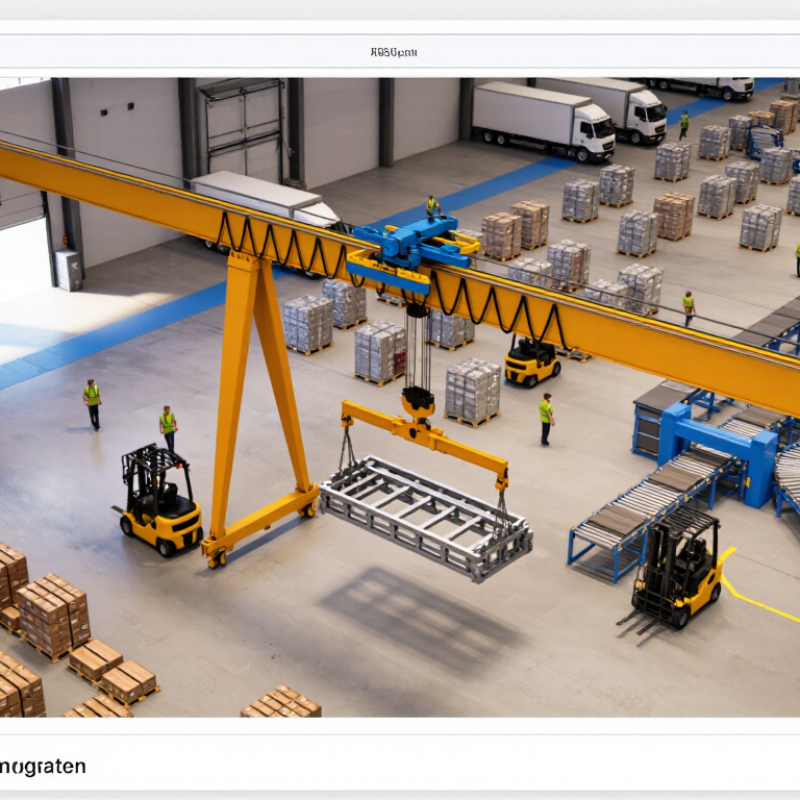
| Definition | A bridge crane is an overhead lifting system consisting mainly of parallel runway beams, end trucks, a bridge girder, and a trolley-mounted hoist. | Moves loads through three basic directions: longitudinal travel, cross travel, and vertical lifting. |
| Primary Motion | The bridge travels along elevated runways, while the trolley moves across the bridge and the hoist raises or lowers the load. | Provides controlled coverage across a large rectangular work area without occupying floor aisles. |
| Common Capacity Range | Approximately 1 to 20 metric tonnes is common in warehouses; heavier systems can be engineered for higher capacities. | Supports material handling from packaged components and pallets to machinery, steel products, and maintenance equipment. |
| Typical Span | Often about 6 to 30 metres, depending on the building width, runway arrangement, and required load capacity. | Allows one crane to serve a broad section of the warehouse while reducing the need for multiple lifting points. |
| Typical Lift Height | Common lifting heights range from approximately 3 to 15 metres, subject to building clearance and hoist design. | Makes better use of vertical storage and helps position loads on racks, platforms, production lines, or transport vehicles. |
| Load Handling Method | The hoist uses wire rope or load chain with suitable hooks, slings, grabs, magnets, spreader beams, or other approved attachments. | Makes the crane adaptable to different load shapes, weights, lifting points, and handling processes. |
| Control Options | Pendant controls, radio remote controls, or a cabin can be used, depending on visibility, duty cycle, and operating conditions. | Enables operators to control load movement from a practical and safe position. |
| Floor-Space Requirement | The main crane structure is installed above the working area rather than on the warehouse floor. | Keeps aisles and floor space available for storage, forklifts, vehicles, workstations, and pedestrian routes. |
| Operational Speed | Lifting, trolley, and bridge travel speeds are selected according to load weight, handling precision, travel distance, and duty classification. | Balances productivity with accurate positioning and reduced load swing. |
| Duty Classification | Crane duty is selected from expected lifting frequency, average load, operating hours, and starts per hour; classifications vary by applicable standard. | Helps ensure the structure, motors, brakes, and hoist are suitable for the warehouse workload. |
| Safety Features | Typical features include overload protection, emergency stop controls, upper-limit switches, brakes, buffers, audible warnings, and travel-limit devices. | Reduces the risk of overloads, unintended movement, over-travel, and uncontrolled load descent when correctly maintained and operated. |
| Installation Requirements | The building must be checked for runway support, column strength, headroom, electrical supply, floor conditions, access, and maintenance clearance. | Ensures the crane integrates safely with the existing warehouse structure and workflow. |
| Maintenance Needs | Regular inspections typically cover wire ropes or chains, hooks, brakes, wheels, rails, electrical components, limit switches, and structural connections. | Supports dependable operation, early fault detection, and compliance with applicable workplace-safety requirements. |
| Best-Suited Applications | Loading and unloading, machine movement, pallet handling, fabrication, maintenance work, assembly, and storage-area transfer operations. | Provides a flexible lifting solution where loads are frequently moved within a defined warehouse area. |
| Key Selection Factors | Rated load, span, lift height, operating class, travel distances, cycle frequency, control method, headroom, environment, and future capacity needs. | Helps match the crane to actual warehouse conditions instead of selecting equipment based only on maximum load. |



 © Copyright 2020 Tianjin Tanghaidongyang Valve Co., Ltd. All Rights Reserved.