| Base Film | Polyethylene terephthalate (PET), commonly 50–100 micrometers thick | Provides dimensional stability and supports the printed image during handling and heat pressing | Clear, flexible, heat-resistant, and sufficiently smooth for uniform coating and printing |
| Release Coating | Silicone-based or other controlled-release surface treatment | Allows the cured transfer to separate from the PET film and bond to the fabric | Release behavior may be hot-peel, warm-peel, or cold-peel depending on the sheet design |
| Ink-Receiving Coating | Microporous or polymer-modified coating formulated for water-based textile-transfer inks | Controls ink absorption, dot formation, color density, and image sharpness | Must provide good wetting, rapid ink control, and compatibility with both color and white ink |
| Printed Color Layer | Water-based pigment ink, typically using cyan, magenta, yellow, and black (CMYK) | Creates the visible artwork and reproduces color gradients, fine details, and photographic elements | Printed as a reversed image so that it appears correctly after transfer to the textile |
| White Ink Layer | White water-based pigment ink printed behind the color image | Improves opacity and color brightness, especially on dark or colored fabrics | Layer thickness and curing must be controlled to reduce cracking, poor adhesion, or uneven coverage |
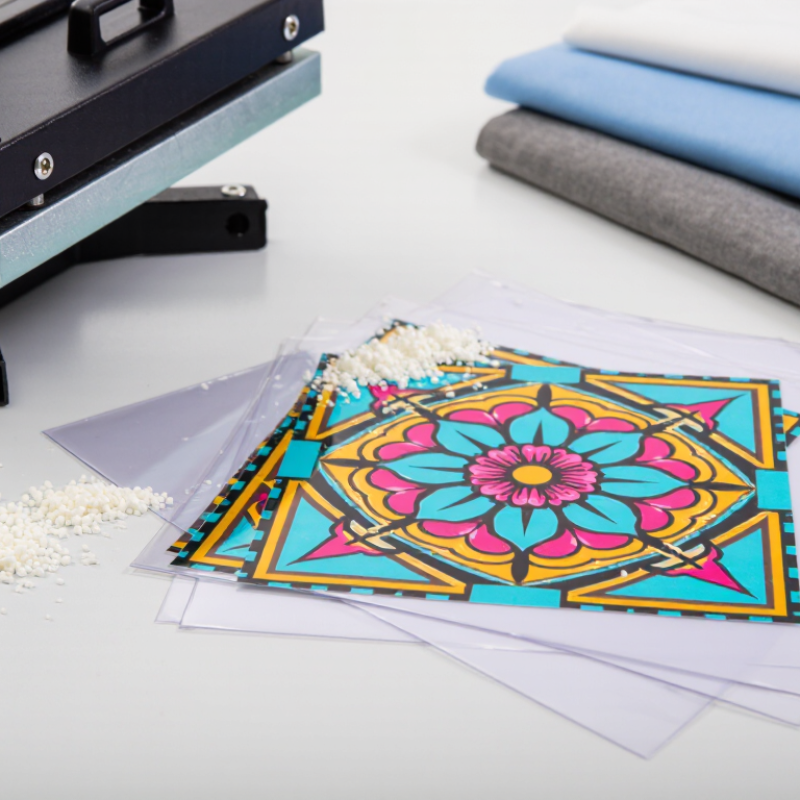
| Hot-Melt Adhesive Powder | Thermoplastic polyurethane (TPU) or comparable textile adhesive powder; particle sizes commonly range from about 80–200 micrometers | Forms the adhesive layer that bonds the printed design to the textile during heat pressing | Requires even coating and complete melting; excess powder should be removed before curing |
| Overall Sheet Format | Rolls or cut sheets; common working widths include approximately 30–60 cm | Supports individual transfers, gang sheets, and continuous production workflows | The selected format should match the printer, powder applicator, curing unit, and heat press |
| Surface Finish | Common finishes include matte, glossy, and lightly textured surfaces | Influences the visual appearance of the transfer before and after application | Finish can affect glare, hand feel, release performance, and the apparent color of the design |
| Typical Heat-Press Range | Approximately 130–160°C for about 10–20 seconds, depending on the transfer system and fabric | Melts the adhesive powder and enables bonding to the textile surface | The exact temperature, pressure, and dwell time must follow the material supplier’s tested instructions |
| Compatible Textile Types | Cotton, polyester, cotton–polyester blends, and selected coated or synthetic fabrics | Provides a versatile decoration method for apparel, bags, uniforms, and other textile products | Compatibility varies by adhesive formulation; always test adhesion, wash durability, stretch, and color migration |



 © Copyright 2020 Tianjin Tanghaidongyang Valve Co., Ltd. All Rights Reserved.