Certificates

Certificates

China Top 10 Sugar Storage Jar Manufacturers for Buyers

China has become a major sourcing base for household food-storage products, including the Sugar Storage Jar. Its strength comes from broad glass, ceramic, stainless-steel, and packaging supply chains. However, factory scale alone does not guarantee dependable quality.

Grand View Research’s Food Storage Container Market Size, Share & Trends Analysis Report identifies convenience, reusable packaging, and organized kitchens as key demand drivers. Smithers’ packaging outlook also highlights sustainability and material transparency as growing purchasing concerns. These findings matter to buyers comparing Chinese manufacturers. A jar may look attractive online, yet its lid seal, glass thickness, printing durability, and carton protection decide its real performance.

This guide reviews China’s top 10 Sugar Storage Jar manufacturers through practical buying criteria. These criteria include production experience, material traceability, mold capability, quality-control systems, export history, and customization support. Food-contact compliance should be checked against the destination market, such as EU or United States requirements. Ask for test reports, factory audit records, sample approvals, and packaging photographs.

Small details matter.

For example, a silicone gasket that shifts during filling can invite moisture and clumping. A weak handle may fail after repeated opening. Buyers should also compare minimum order quantities, lead times, replacement policies, and inspection procedures. Manufacturer rankings are useful, but they are not final judgments. Supplier capacity can change, and public information may remain incomplete. Direct verification is still necessary. This introduction therefore treats the list as a sourcing starting point, not a guarantee.

China Top 10 Sugar Storage Jar Manufacturers for Buyers

China’s Sugar Storage Jar Manufacturing Industry

China’s sugar storage jar manufacturing industry is moving toward safer, cleaner, and more traceable production.

China Customs data for HS 7013 shows strong international trade activity in glass tableware and household containers. The China Packaging Federation also reports continued growth in food-contact packaging demand, supported by online grocery sales and modern kitchen design. These trends encourage factories to improve glass clarity, lid sealing, labeling, and batch inspection.

Manufacturers commonly produce jars from soda-lime glass, stainless steel, silicone, and food-grade plastics. Glass remains popular because it resists odor absorption and shows the sugar level clearly. Automated forming lines can improve consistency, but manual inspection still matters.

Small defects can appear around the neck or thread. Those details affect sealing performance. A 2024 report from Mordor Intelligence identifies Asia-Pacific as a major growth region for household storage products, although market estimates differ between research firms. This is worth remembering.

Tips:

Ask for food-contact test reports, material declarations, and recent factory audit records. Check lid torque, gasket recovery, and drop-test results. Request samples before discussing large orders. A beautiful jar may still have an unreliable seal. Also inspect carton dividers, because transport damage often begins with weak inner protection. For buyers comparing China’s top manufacturers, production capacity is only one measure. Process control, documentation, and after-sales responsiveness deserve equal attention. Some suppliers may provide excellent samples but inconsistent bulk production. That risk should be tested, not assumed.

Key Factors for Evaluating Chinese Sugar Jar Manufacturers

Choosing among China’s top sugar storage jar manufacturers requires more than comparing catalog photos and quoted prices. A reliable supplier should explain its materials, sealing process, mold capability, and inspection routine clearly. Ask whether the jar uses food-contact-safe materials for your target market. Request recent test reports, production photos, and a sample from current stock. A polished website is not proof of factory capacity.

I have found that small details reveal manufacturing discipline. Check the lid thread, silicone gasket, glass thickness, and base stability. Fill the sample with sugar, turn it upside down, and inspect it after several hours. Examine the inner surface for chips, rough edges, or trapped dust. Discuss mold fees, minimum order quantities, replacement policies, and realistic lead times. Cheap quotations can hide weak packaging or inconsistent batches.

Tips: Use a written evaluation sheet for every manufacturer. Record sample results, document dates, response speed, and corrective actions. A video tour helps, but an independent inspection provides stronger evidence. Confirm carton strength with a drop test before mass production. Also, ask how rejected jars are separated and recorded. Communication may feel smooth at the beginning, yet production changes can expose gaps. Leave critical specifications in writing, even when the supplier seems experienced.

China Top 10 Sugar Storage Jar Manufacturers for Buyers - Key Factors for Evaluating Chinese Sugar Jar Manufacturers

Indicative Chinese manufacturing-market benchmarks for buyer evaluation. Actual specifications, prices, certifications, and lead times should be confirmed with each supplier before ordering.
Rank Anonymous Manufacturer Profile Primary Product Strength Common Materials Typical Capacity Range Lid and Seal Options Customization Capability Food-Contact Documentation to Request Indicative MOQ Sample Lead Time Bulk Lead Time Key Buyer Verification Point
1 Profile A Clear glass countertop jars Soda-lime glass, stainless steel, silicone 500 ml–2,000 ml Clamp lid, screw lid, silicone gasket Shape, lid finish, decal, carton packaging Food-contact declaration, migration test, material specification 500–1,000 units 7–15 days 25–45 days Check glass thickness, edge finishing, and gasket fit.
2 Profile B Borosilicate glass storage jars Borosilicate glass, bamboo, silicone 400 ml–1,500 ml Wood-style lid, silicone seal, threaded cap Lid material, surface marking, gift-box packaging Glass composition statement, food-contact test report, sealant declaration 1,000–2,000 units 10–18 days 30–50 days Confirm thermal-shock performance and lid odor resistance.
3 Profile C Plastic and lightweight pantry containers PP, PET, Tritan-type copolyester, silicone 600 ml–3,000 ml Snap-on lid, flip-top lid, silicone gasket Color matching, printed markings, injection-molded shapes Resin identification, food-contact compliance, migration test 2,000–5,000 units 10–20 days 35–60 days Verify resin grade, odor performance, and dimensional stability.
4 Profile D Ceramic and stoneware sugar jars Ceramic, porcelain, silicone, wood 300 ml–1,200 ml Ceramic lid, wooden lid, silicone ring Glaze color, decals, embossing, retail packaging Glaze migration report, heavy-metal test, material declaration 1,000–3,000 units 12–20 days 40–70 days Inspect glaze consistency, pinholes, cracks, and lid alignment.
5 Profile E Metal-bodied storage containers Stainless steel, tinplate, food-grade silicone 500 ml–2,500 ml Press-fit lid, threaded lid, silicone seal Brushed finish, powder coating, laser marking Steel grade certificate, coating test, food-contact declaration 1,000–3,000 units 10–18 days 30–55 days Confirm corrosion resistance and absence of sharp edges.
6 Profile F Airtight premium kitchen jars Glass, stainless steel, ABS or PP components, silicone 500 ml–2,000 ml Four-side clamp, silicone gasket, locking lid Closure design, color, labeling, multi-piece sets Seal-material declaration, migration test, airtightness test method 500–1,500 units 7–15 days 25–45 days Test seal compression, opening force, and repeated-use durability.
7 Profile G Small-batch private-label production Glass, PP, PET, bamboo, silicone 250 ml–1,500 ml Screw lid, snap lid, clamp lid Labels, stickers, simple color changes, inserts Component material list, food-contact declaration, batch traceability 300–800 units 7–14 days 20–40 days Confirm whether the quoted MOQ applies to each color and size.
8 Profile H Large-volume food-storage packaging Thick-wall glass, PP, HDPE, silicone 1,000 ml–5,000 ml Threaded lid, screw cap, gasketed cover Capacity, handle, carton configuration, pallet loading Material declaration, migration report, packaging and pallet specification 2,000–5,000 units 12–20 days 35–60 days Review drop-test results, carton strength, and container weight tolerance.
9 Profile I Decorative and gift-oriented jars Glass, ceramic, bamboo, stainless steel 300 ml–1,000 ml Decorative lid, wood lid, gasketed cover Color, pattern, decal, sleeve, gift box Decoration compliance, glaze or coating test, food-contact declaration 1,000–3,000 units 15–25 days 45–75 days Check color consistency, print adhesion, and retail-pack protection.
10 Profile J Export-oriented mixed-material programs Glass, ceramic, PP, stainless steel, bamboo 300 ml–3,000 ml Clamp, screw, snap, or gasketed lids Multi-material development, artwork, assortment packing Food-contact declaration, test reports for every food-contact component, traceability records 1,000–5,000 units 10–20 days 35–65 days Verify export experience, inspection procedures, and Incoterms in the quotation.

Top 10 Sugar Storage Jar Manufacturers in China

China Top 10 Sugar Storage Jar Manufacturers for Buyers

China’s top 10 sugar storage jar manufacturers serve household, hospitality, and food-service buyers. The strongest suppliers usually offer glass, ceramic, stainless steel, or food-grade plastic options. UNIDO’s International Yearbook of Industrial Statistics 2024 places China among the world’s largest manufacturing economies. This scale supports flexible tooling, competitive production, and export experience. However, factory size alone proves little.

Buyer experience shows that reliable sourcing depends on material traceability and process control. Ask for food-contact test reports, batch records, lid compatibility data, and seal durability results. SGS testing or equivalent laboratory evidence can strengthen supplier claims. Grand View Research estimates continued growth in the global glass packaging market through 2030, supported by reuse and recyclability preferences. That trend favors durable jars with replaceable seals and practical dispensing openings.

Small details matter.

A good manufacturer should provide clear dimensions, empty weight, carton protection, and sample approval procedures. Check whether sugar clumps around the lid after repeated opening. Test the jar under humid kitchen conditions. A polished sample can mislead. I would not rely on catalog photos or the lowest quotation. Some suppliers need stronger English documentation, and delivery estimates may change during peak production periods. Buyers should compare at least three quotations, inspect pre-shipment samples, and confirm packaging performance before placing larger orders.

Product Types, Materials, and Customization Options

China Top 10 Sugar Storage Jar Manufacturers for Buyers

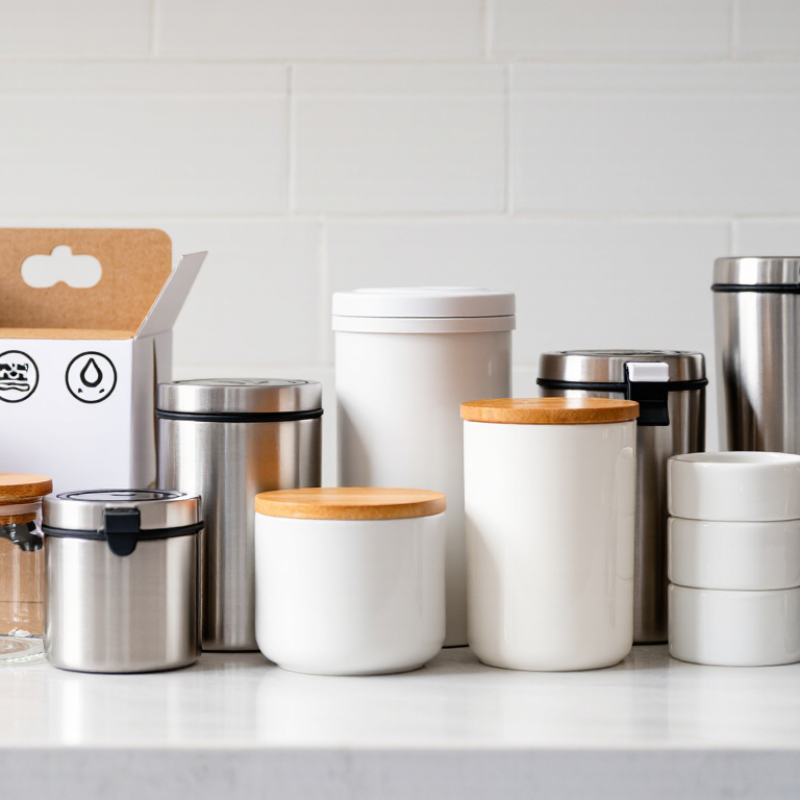
China’s leading sugar storage jar manufacturers usually offer glass, ceramic, stainless steel, and food-grade plastic designs. Common product types include countertop jars, stackable containers, clip-top jars, and measuring-lid models. Clear glass helps users check sugar levels quickly. Ceramic versions suit kitchens that need warmer colors and heavier bodies. Stainless steel works well where light resistance and toughness matter. Plastic jars are lighter, but buyers should examine odor retention and surface scratches.

Material quality deserves careful checking. Look for smooth inner walls, stable bases, and lids that close without excessive force. Silicone gaskets can improve sealing, especially in humid kitchens. Ask suppliers for material declarations, food-contact test reports, and batch inspection records. These documents are more useful than attractive catalog photos. A thick jar is not automatically safer. Poorly finished edges can still cause problems.

Customization may include capacity, lid style, color, surface texture, packaging, and printed measurements. Buyers can request sample sets in 500 ml, 800 ml, or 1,000 ml sizes to compare handling. Custom molds usually increase cost and require longer development time. Confirm logo placement, color tolerance, carton strength, and drop-test expectations before mass production. Small details matter. In my view, one weakness in many purchasing plans is overvaluing appearance. A polished sample may hide inconsistent sealing or uneven printing, so repeated checks remain necessary.

Buyer Guide to Quality, Pricing, and Supplier Verification

China Top 10 Sugar Storage Jar Manufacturers for Buyers

Selecting among China’s top sugar storage jar manufacturers requires more than comparing product photos. Grand View Research’s 2024 food storage container analysis forecasts steady market growth through 2030, with hygiene and reusable materials driving demand. Treat that forecast carefully. Market definitions vary. For sugar jars, inspect food-contact glass, lid material, gasket fit, and moisture resistance. A practical test is simple: fill a sample jar with granulated sugar for seven days. Check clumping, odor transfer, and lid tension.

Pricing depends on capacity, glass thickness, decoration, packaging, and order volume. Request quotations using identical specifications, such as 500 ml capacity, borosilicate or soda-lime glass, and a silicone seal. Compare EXW and FOB prices separately. The cheapest offer may exclude cartons, inspection, or replacement parts. UN Comtrade data shows China remains a major global exporter of glassware, but export scale does not prove factory quality.

Verify each shortlisted supplier through a live video tour, business registration, production photographs, and recent test reports. Ask for migration testing against the destination market’s food-contact requirements. ISO 2859-1 provides a recognized sampling framework for acceptance inspections; agree on the inspection level before production. Check carton drop tests, barcode accuracy, and lid assembly by hand. Request a paid sample first. I would not trust a polished certificate alone. Supplier records can age, and product specifications sometimes change quietly. Insist that approved samples, tolerances, and packaging details appear in the purchase contract.