| Direct-to-Garment Textile Inkjet | Print heads spray liquid textile ink directly onto the sock surface. The sock is usually mounted over a cylindrical fixture to keep the fabric positioned during printing. | Cotton, polyester, nylon, and blended knitted fabrics, depending on the ink formulation and pretreatment. | Supports detailed artwork, gradients, photographs, and short production runs with relatively little setup. | Ink adhesion, color depth, and wash durability depend strongly on fabric preparation, curing, and ink compatibility. | Personalized socks, promotional products, small-batch collections, and photo-based designs. |
| Dye-Sublimation Transfer | A design is printed with sublimation dye onto transfer paper and then heated. The dye changes into a gas and bonds with compatible polyester fibers. | Primarily white or light-colored polyester and polyester-rich blends. | Produces vivid, lightweight prints that become part of the fiber surface and do not create a thick raised layer. | Generally unsuitable for cotton and dark fabrics without additional processes; heat can affect elastic components if poorly controlled. | Sports socks, full-color polyester designs, all-over patterns, and customized athletic apparel. |
| Screen Printing | Ink is pushed through a stencil-covered mesh screen onto the sock. Each color normally requires a separate screen and controlled registration. | Cotton, polyester, nylon, and blends when the ink and curing method are properly selected. | Provides strong opacity, durable solid colors, and efficient production for repeated designs and larger quantities. | Requires screen preparation, color separation, and accurate alignment; fine gradients and highly detailed images are more difficult. | Team socks, uniform designs, logos, lettering, and high-volume orders with limited colors. |
| Rotary Screen Printing | Cylindrical screens rotate while applying ink to a continuously positioned sock or tubular textile, allowing repeating patterns around the circumference. | Knitted cotton, polyester, nylon, and blended tubular fabrics compatible with textile inks. | Efficient for consistent repeating patterns and larger production volumes; suitable for continuous textile workflows. | Higher preparation costs and less flexibility for one-off designs; registration and fabric stretch must be carefully controlled. | Repeated stripes, patterned socks, and large-scale production of standardized designs. |
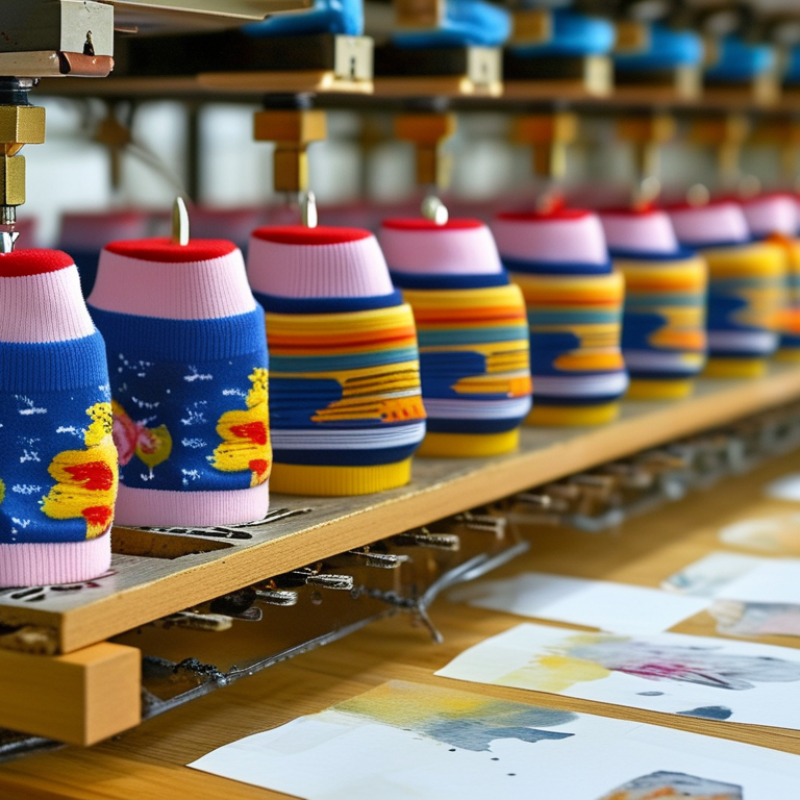
| Digital Knitting | A computerized knitting machine selects and interloops different colored yarns while constructing the sock, so the design becomes part of the knitted structure. | Cotton, polyester, nylon, wool, elastane-containing yarn systems, and other knitting-compatible fibers. | Excellent durability, no surface ink layer, integrated patterns, and good suitability for designs that follow the sock shape. | Color and image detail are limited by yarn selection, stitch structure, gauge, and the physical resolution of the knitting machine. | Jacquard patterns, text, stripes, athletic socks, and premium knitted designs. |
| Heat-Transfer Vinyl or Film | A design is cut or printed onto a heat-transfer film, weeded when necessary, and bonded to the sock using pressure and heat. | Smooth polyester, cotton, and selected blends with a stable surface and suitable heat resistance. | Useful for names, numbers, simple graphics, and small quantities; can provide strong color coverage. | The film may feel raised, reduce stretch, crack if poorly applied, or peel when fabric preparation and curing are inadequate. | Names, numbers, simple symbols, limited-edition products, and quick customization. |
| Embroidery | A programmable needle machine stitches thread directly into the sock or into a separately prepared patch that is attached afterward. | Structured or reinforced areas of cotton, polyester, nylon, and blended socks; very thin knits may require stabilizing support. | Creates a textured, premium appearance with strong resistance to surface fading and abrasion. | Not ideal for photographic detail, large filled areas, or highly elastic zones; stitching can add weight and reduce stretch. | Monograms, small emblems, premium casualwear, workwear, and decorative sock patches. |


 © Copyright 2020 Tianjin Tanghaidongyang Valve Co., Ltd. All Rights Reserved.