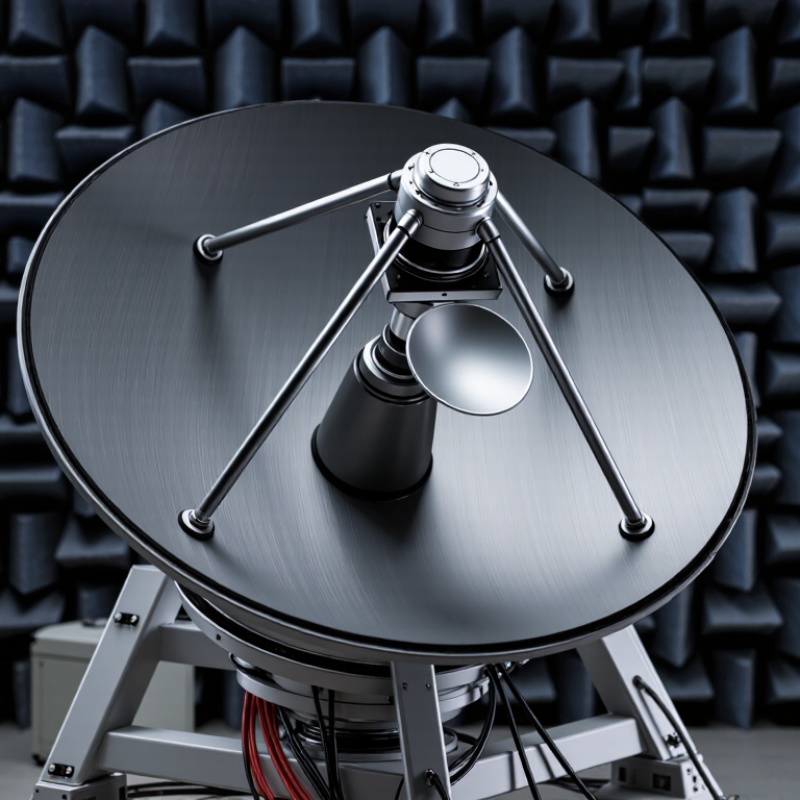
| Main Reflector | Parabolic dish with a rotationally symmetric reflecting surface | Collects incoming electromagnetic energy and converts it into a focused wavefront | Determines aperture efficiency, gain, beamwidth, and much of the antenna's frequency response |
| Subreflector | Smaller convex reflector positioned near the main reflector's focal region | Redirects the signal between the main reflector and the feed located near the rear of the dish | Supports a compact feed arrangement and helps reduce feed-line loss |
| Feed Horn or Feed Assembly | Waveguide-based feed designed for the operating frequency band | Launches transmitted energy toward the reflectors and receives focused energy in the receive path | Influences impedance matching, polarization purity, sidelobes, and illumination efficiency |
| Feed Support Structure | Rigid struts, tripod, or rear-mounted support system | Maintains the feed and subreflector at their designed positions | Mechanical displacement can cause phase errors, gain reduction, and increased sidelobe levels |
| Reflector Surface Accuracy | Surface deviation typically specified as a fraction of the operating wavelength | Preserves the intended phase relationship across the aperture | Higher accuracy generally improves gain and reduces pattern distortion, especially at higher frequencies |
| Aperture Diameter | Common precision systems range from approximately 0.6 m to several meters | Sets the physical collecting area of the antenna | A larger aperture generally provides higher gain and a narrower main beam at the same frequency |
| Operating Frequency | Application-dependent microwave or millimeter-wave band | Defines the wavelength used to size and evaluate the reflector, feed, and waveguide | Higher frequencies require tighter dimensional tolerances but can deliver narrower beams with the same aperture |
| Polarization Control | Linear or circular polarization, depending on the feed and application | Controls the orientation and electrical characteristics of the transmitted or received field | Accurate polarization alignment improves link quality and reduces cross-polarization interference |
| Antenna Gain | Often approximately 30–55 dBi, depending on aperture size, frequency, and efficiency | Describes the antenna's directional concentration of radiated or received power | Higher gain improves long-distance link budgets but requires more accurate pointing |
| Beamwidth | Typical half-power beamwidth may range from less than 1° to several degrees | Indicates the angular width of the main radiation lobe | A narrow beam improves spatial selectivity but increases sensitivity to alignment errors |
| Pointing and Mounting System | Azimuth-elevation, polar, or other precision tracking mount | Directs the main beam toward the target and compensates for platform or target movement | Pointing accuracy must be appropriate for the antenna's beamwidth to maintain stable signal strength |
| Typical Applications | Satellite communications, radio astronomy, radar, telemetry, and high-capacity microwave links | Provides highly directional transmission and reception where signal isolation is important | Enables high link margins, frequency reuse, interference rejection, and precise spatial observation |



 © Copyright 2020 Tianjin Tanghaidongyang Valve Co., Ltd. All Rights Reserved.