| Application Compatibility | Material being conveyed, particle size, concentration, temperature, pressure, vacuum, bending movement, and installation orientation. | Review the hose technical datasheet and compare it with the actual operating conditions. | The selected hose should be rated for the maximum continuous temperature and pressure, including start-up, shutdown, surges, and vacuum conditions. | Critical |
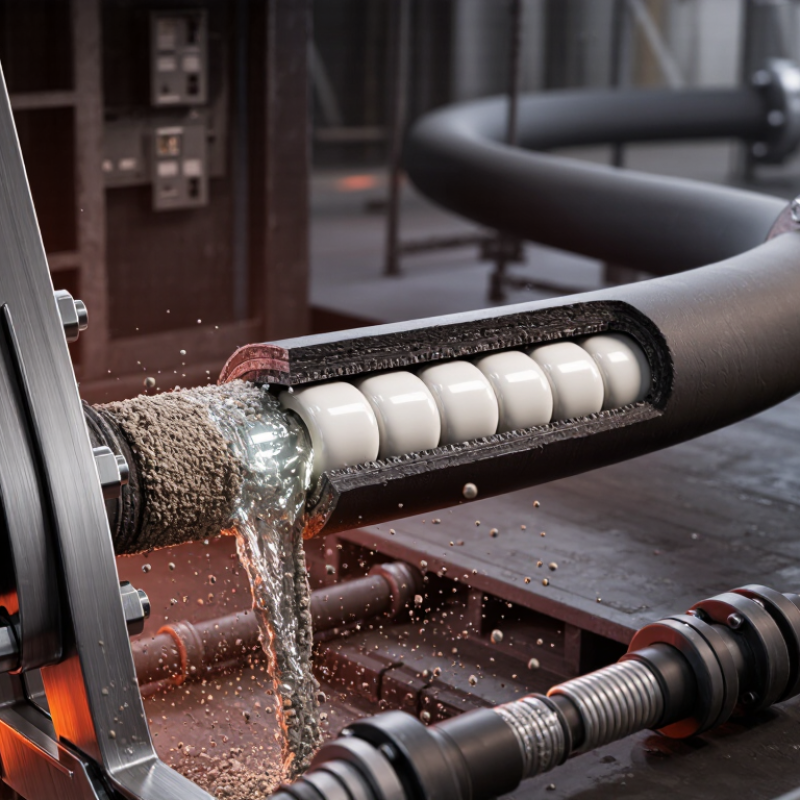
| Ceramic Lining Design | Ceramic tile or cylinder arrangement, lining thickness, joint layout, bonding method, and coverage of high-wear areas. | Inspect drawings, cross-sections, sample sections, and product quality records. | The lining should provide continuous protection through bends and elbows without exposed rubber gaps at the intended wear zone. | Critical |
| Abrasion Resistance | Resistance to sliding and impact wear from sand, ore, ash, cement, slurry, or other abrasive media. | Request abrasion-test results using a recognized method such as ISO 4649 or ASTM D5963, where applicable. | Test conditions should resemble the actual conveyed material. A test result without the abrasive type, load, speed, and temperature is not sufficient for comparison. | Critical |
| Bond Strength | Adhesion between the ceramic elements, rubber matrix, and hose reinforcement; resistance to tile loosening during flexing. | Review destructive bond testing, peel or pull-off testing, and production inspection records. | Failure should not occur at the ceramic-rubber interface under the specified operating and flexing conditions. Test method and minimum value must be documented. | Critical |
| Pressure Rating | Working pressure, proof pressure, burst pressure, pressure pulsation, and pressure spikes. | Verify compliance with the applicable hose construction and pressure-test requirements, such as ISO 1307 where relevant. | The maximum working pressure should exceed the highest measured system pressure with an appropriate engineering safety margin. Do not use burst pressure as the operating limit. | Critical |
| Temperature Resistance | Continuous temperature, short-term peak temperature, thermal cycling, and temperature at the hose wall rather than only at the process line. | Compare the rubber compound rating with the media temperature and verify thermal-aging or heat-resistance data. | The operating temperature should remain within the compound manufacturer's continuous rating. Repeated excursions above the rating can accelerate hardening, cracking, and bond failure. | Critical |
| Chemical Compatibility | Compatibility of the rubber, ceramic, adhesive, tube, and cover with acids, alkalis, oils, solvents, salts, and process additives. | Use fluid-resistance data according to ISO 1817 or an equivalent recognized test method. | The test fluid, concentration, temperature, exposure time, volume change, hardness change, and visual condition should be reported. | Critical |
| Flexibility and Minimum Bend Radius | Minimum dynamic and static bend radius, repeated movement, torsion, and whether the ceramic lining can follow the hose curvature. | Check the manufacturer's bend-radius specification and perform a movement trial using the actual routing. | The installed bend radius should not be below the stated minimum. Avoid twisting, sharp kinks, unsupported weight, and bending directly behind rigid couplings. | Critical |
| Dimensional Accuracy | Inside diameter, outside diameter, wall thickness, length, flange dimensions, and concentricity. | Measure finished dimensions against the approved drawing and applicable hose dimensional requirements, including ISO 1307 where applicable. | Dimensions should remain within the agreed drawing tolerances and must allow correct coupling fit, flow area, and installation clearance. | Important |
| Reinforcement Quality | Cord or wire type, reinforcement layers, cover integrity, splice quality, and resistance to pressure and external damage. | Review construction drawings, production inspection records, and pressure or impulse testing where applicable. | Reinforcement must match the pressure, vacuum, movement, and external-load requirements. No exposed reinforcement, blisters, cuts, or irregular splices should be accepted. | Critical |
| Leak and Pressure Testing | Leak tightness, proof-pressure performance, end-fitting integrity, and pressure retention. | Require a documented hydrostatic or pneumatic test procedure appropriate to the hose design and service risk. | Each finished hose should have traceable test results when required by the application. The test pressure, duration, medium, and acceptance criteria must be recorded. | Critical |
| Visual and Ceramic Inspection | Cracks, chips, voids, exposed rubber, uneven joints, delamination, blisters, cover damage, and flange-area defects. | Perform 100% visual inspection and, for critical service, use suitable non-destructive or sectioning checks. | Ceramic pieces should be firmly seated, with no loose sections or open paths that could allow abrasive media to reach the rubber substrate. | Critical |
| Estimated Service Life | Expected wear rate, replacement interval, failure history, operating duty cycle, and inspection frequency. | Use application-specific field data, wear monitoring, and documented reference installations without relying only on a generic lifetime claim. | A defensible estimate should state the medium, flow velocity, temperature, pressure, duty cycle, hose geometry, and inspection basis. Service life is application-dependent and cannot be guaranteed by hose material alone. | Critical |
| Weight and Handling | Finished hose weight, lifting points, support spacing, coupling weight, and operator handling requirements. | Compare the certified mass and installation instructions with the available supports and lifting equipment. | The support system should carry the hose when full and should prevent excessive load on couplings, flanges, and moving equipment. | Important |
| End Connections | Flange or coupling type, pressure class, sealing face, bolt pattern, liner continuity, and galvanic or chemical compatibility. | Verify against the approved piping drawing and applicable connection standard. | Connections should align without forcing the hose. The ceramic-lined flow path should not create a sharp step, exposed edge, or obstruction at the joint. | Critical |
| Traceability | Hose identification, batch number, production date, dimensions, pressure rating, material designation, and test record. | Check the marking, certificate, inspection report, and packing list. | Every hose should be traceable to its production batch and inspection results, especially when used in high-pressure, hazardous, or difficult-to-access locations. | Important |
| Supplier Technical Support | Engineering review, sizing assistance, installation instructions, routing guidance, troubleshooting, and replacement recommendations. | Evaluate the quality and completeness of the technical submittal before purchase. | The supplier should provide a clear datasheet, approved drawing, installation limits, inspection procedure, and a named technical contact. | Critical |
| Warranty and Claims Process | Warranty duration, exclusions, evidence requirements, response time, and corrective-action procedure. | Review the written warranty and service terms rather than relying on verbal assurances. | The warranty should define coverage for manufacturing defects, ceramic delamination, leakage, and premature failure, with clear reporting and investigation steps. | Important |
| Spare Parts and Lead Time | Availability of replacement hoses, matching couplings, emergency production capability, and delivery time. | Request standard and expedited lead times, minimum order quantities, and recommended spare quantities. | For critical lines, maintain at least one correctly specified spare or establish a documented replacement plan based on risk and historical consumption. | Important |
| Installation and Maintenance | Storage conditions, cleaning method, support arrangement, inspection points, wear indicators, and replacement criteria. | Follow the supplier's installation manual and establish a site inspection checklist. | The inspection plan should include visual checks, leakage checks, cover condition, coupling condition, bend-radius compliance, and measured wall or lining wear where feasible. | Critical |
| Total Cost of Ownership | Purchase price, installation, support hardware, downtime risk, inspection cost, replacement frequency, and disposal. | Compare lifecycle cost rather than purchase price alone. | A higher initial cost may be justified when the hose provides verifiable wear life, reduced change-out frequency, lower downtime, and reliable technical support. | Important |


 © Copyright 2020 Tianjin Tanghaidongyang Valve Co., Ltd. All Rights Reserved.