| Electrolysis method | Alkaline water electrolysis | Uses an aqueous alkaline electrolyte to conduct ions between two electrodes. |
| Main input | Water, electricity, and an alkaline electrolyte such as potassium hydroxide or sodium hydroxide | Electricity drives the chemical reaction, while the electrolyte improves ionic conductivity. |
| Electrochemical reaction | 2H₂O → 2H₂ + O₂ | Water is split into hydrogen at the cathode and oxygen at the anode. |
| Hydrogen production site | Cathode, also called the negative electrode | Water molecules receive electrons and form hydrogen gas and hydroxide ions. |
| Oxygen production site | Anode, also called the positive electrode | Hydroxide ions release electrons and form oxygen and water. |
| Ion transport | Hydroxide ions move through the alkaline electrolyte from the cathode toward the anode. | Ion movement completes the internal electrical circuit. |
| Typical electricity consumption | Approximately 50–60 kWh per kg of H₂ | Actual consumption varies with stack efficiency, operating pressure, power electronics, cooling, water treatment, and gas purification. |
| Theoretical minimum energy | About 39.4 kWh per kg H₂ based on the higher heating value of hydrogen | Real systems require more energy because of electrical, thermal, gas-processing, and auxiliary losses. |
| Water consumption | The stoichiometric requirement is about 9 kg of water per kg of H₂; practical plant intake is higher. | Additional water may be needed for purification, cooling, flushing, and system losses. |
| Hydrogen output pressure | Often produced at several to a few tens of bar, depending on system design | Higher delivery pressure can reduce downstream compression requirements but may increase energy use. |
| Hydrogen purity | Commonly around 99.5%–99.999% after appropriate gas separation and purification | Required purity depends on the end use, such as fuel cells, industrial heating, or chemical production. |
| Operating temperature | Typically about 60–90°C for conventional alkaline electrolyzer systems | Temperature affects reaction kinetics, conductivity, efficiency, and materials durability. |
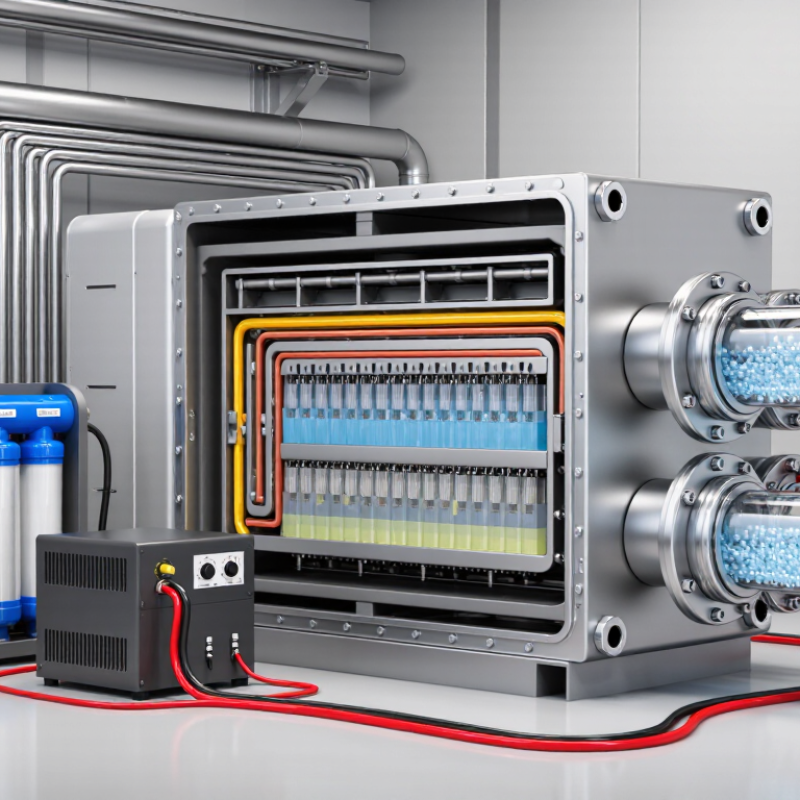
| Core components | Electrolyzer stack, electrodes, diaphragm, electrolyte circulation loop, rectifier, water-treatment unit, gas separator, cooling system, and controls | Each subsystem contributes to safe operation, gas quality, efficiency, and production reliability. |
| Diaphragm function | Separates hydrogen and oxygen compartments while allowing ion transport | Helps prevent gas mixing and supports safe, high-purity hydrogen production. |
| Dynamic response | Generally slower than proton-exchange-membrane systems when following rapidly changing power | Stable electricity supplies and operating buffers can improve performance with variable renewable power. |
| Typical advantages | Mature technology, potentially long operating life, and use of relatively abundant catalyst materials | These characteristics can support large-scale hydrogen production when operating conditions are suitable. |
| Key limitations | Electrolyte handling, possible gas crossover, lower flexibility than some newer designs, and the need for water and gas management | System design and regular monitoring are necessary to maintain efficiency and operational safety. |
| Emission profile | No direct carbon dioxide emissions during electrolysis; lifecycle emissions depend mainly on the electricity source. | Using renewable or low-carbon electricity can substantially reduce the climate impact of the produced hydrogen. |



 © Copyright 2020 Tianjin Tanghaidongyang Valve Co., Ltd. All Rights Reserved.