2026 Top Carbide Ring Types for Global Buyers?
The 2026 carbide ring market is becoming more application-driven, not simply price-driven. Global buyers now compare ring types by hardness, toughness, dimensional stability, and service environment. A ring used in a mining seal faces different stresses from one installed in an industrial valve. The difference can be visible under a microscope, yet costly in production.
Dr. Karl Schröter, widely recognized as a pioneer of cemented carbide, is associated with the practical principle: “Performance depends on balancing hardness with toughness.” This principle remains useful when evaluating tungsten carbide rings for oil seals, mechanical seals, wear assemblies, and precision tooling. High hardness can resist abrasion, but excessive hardness may reduce impact resistance. Cobalt content, carbide grain size, density, and surface finish all influence real performance.
This guide examines the top carbide ring types expected to attract global buyers in 2026. It considers standard rings, custom-engineered rings, grooved designs, split rings, and seal-grade variants. Each section connects material choices with operating conditions, manufacturing tolerances, inspection methods, and supplier reliability. Ask for test data.
Practical purchasing experience also reveals uncomfortable details. A low quotation may hide unstable dimensions, inconsistent grinding, or weak documentation. Even an excellent grade can fail when the fit is wrong. Buyers should verify drawings, batch traceability, hardness data, tolerances, and quality systems before approving samples. The ranking cannot predict every application. It is a decision framework, not a promise. Real service conditions must remain the final test.
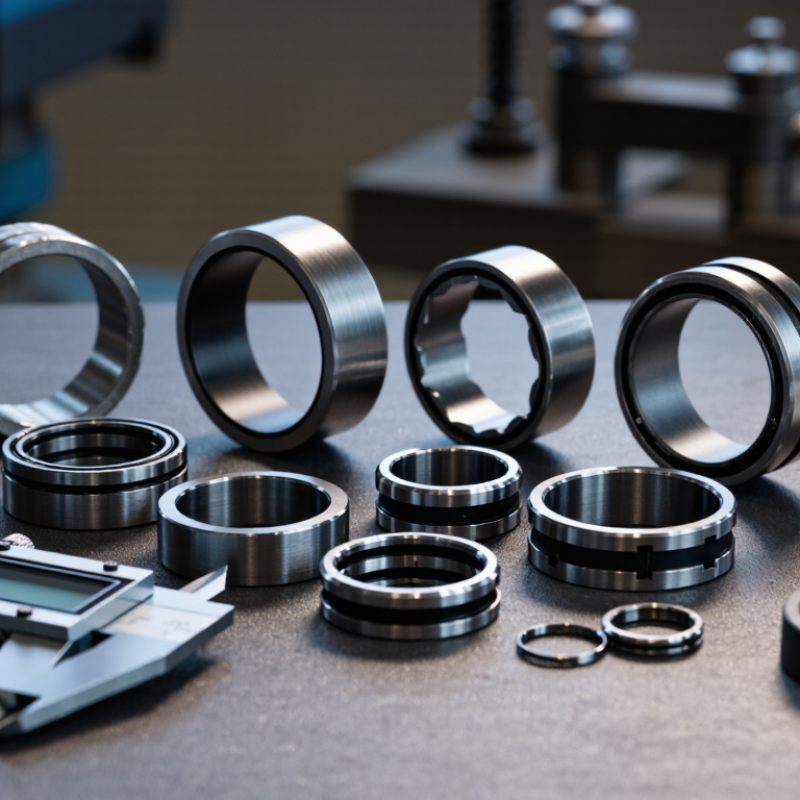
Carbide Ring Fundamentals: WC–Co Grades, 85–95% WC, and 14.5–15.1 g/cm³
Carbide ring selection starts with composition, not appearance.
WC–Co grades usually contain 85–95% tungsten carbide, with cobalt acting as the binder. More WC normally improves hardness and wear resistance. More cobalt usually improves toughness and impact tolerance.
Density matters. A typical 85% WC grade may measure near 14.5 g/cm³, while 95% WC grades can approach 15.1 g/cm³. These values help buyers verify certificates and detect incorrect material descriptions.
The U.S. Geological Survey’s Mineral Commodity Summaries 2025 reported approximately 81,000 metric tons of global tungsten mine production in 2024. This supply data matters because tungsten content affects cost, availability, and lead-time risk.
ASTM B311 provides a recognized method for measuring sintered material density. In practical purchasing, request WC percentage, cobalt percentage, density, hardness, transverse rupture strength, and test method.
A dense ring is not automatically the best ring. I have seen buyers overvalue density and overlook edge chipping during assembly.
Tips: Match the grade to the load. Choose higher WC for steady abrasion, and a tougher cobalt-rich grade for shock or vibration. Ask for batch-level inspection records, not only a standard catalogue range. Small density differences can expose large composition differences. Measure it.
Hardness and Wear Data: 1,500–2,400 HV and Mohs 9 for WC Rings
For global buyers, tungsten carbide rings are judged by more than appearance. Their main advantage is exceptional hardness. Depending on grade, binder content, and testing method, WC rings can measure about 1,500–2,400 HV. That range is close to Mohs 9, making the surface highly resistant to scratching from everyday contact.
Hardness is not the whole story. Standard sintered carbide rings suit general wear and stable production costs. Fine-grain grades offer smoother polishing and better edge strength. Binderless carbide can provide higher wear resistance, but it may be less forgiving under sudden impact. A ring can resist scratches yet chip at a sharp edge.
Ask for the actual hardness test method. Vickers values are usually reported as HV30 or HV10, and results can change with load and surface preparation. Check density, grain size, cobalt content, coating thickness, and dimensional tolerance. These details matter when a ring must fit tightly or survive abrasive dust. Requesting a sample is sensible. It may expose polishing marks, uneven color, or a brittle edge before a large order. I would not rely on “Mohs 9” alone. It is a useful comparison, but it does not predict impact performance, thermal cycling, or long-term comfort. Small design choices matter. Curved edges usually reduce chipping risk, while sharp profiles look distinctive but demand more careful handling.
2026 Top Carbide Ring Types for Global Buyers? - Hardness and Wear Data: 1,500–2,400 HV and Mohs 9 for WC Rings
| Carbide Ring Type | Typical Composition | Typical Hardness
(HV30) | Approx. Mohs
Hardness | Density
(g/cm³) | Wear Resistance | Corrosion Performance | Typical Buyer Applications |
| Fine-Grain WC–Co Ring | Tungsten carbide with approximately 6–12% cobalt binder | 1,500–1,900 HV30 | About 8.5–9 | 14.2–14.9 | Very high | Good in dry and mildly corrosive service; binder may be chemically attacked | Mechanical seals, pump components, wear sleeves, forming tools |
| Ultra-Fine-Grain WC–Co Ring | Tungsten carbide with approximately 6–10% cobalt and submicron grains | 1,800–2,200 HV30 | About 9 | 14.3–14.8 | Extremely high | Good, with improved edge strength and surface durability compared with coarser grades | Precision seals, high-cycle wear parts, abrasive slurry equipment |
| Nickel-Binder WC Ring | Tungsten carbide with approximately 8–15% nickel-based binder | 1,400–1,800 HV30 | About 8.5–9 | 13.8–14.7 | Very high | Better resistance to many aqueous and chemically active environments than cobalt-binder grades | Chemical pumps, water-treatment equipment, marine and oil-field components |
| Binderless WC Ring | Near-monolithic tungsten carbide with little or no metallic binder | 2,000–2,400 HV30 | About 9 | 15.0–15.7 | Outstanding | Excellent against many corrosive media, but chemical compatibility must be checked for the process fluid | Extreme abrasion, high-purity processing, precision wear interfaces |
| WC–Ni–Cr Corrosion-Resistant Ring | Tungsten carbide with nickel-chromium metallic binder | 1,500–1,900 HV30 | About 8.5–9 | 13.8–14.8 | Very high | High resistance to corrosion in selected wet, saline, and chemical environments | Desalination equipment, chemical handling, offshore and process pumps |
| WC–TiC–Co–Ni Cermet Ring | Tungsten carbide and titanium carbide with cobalt-nickel binder | 1,500–2,000 HV30 | About 8.5–9 | 11.5–13.5 | High to very high | Generally good; exact performance depends strongly on binder chemistry | Cutting and forming tools, dimensional wear components, high-temperature tooling |
Data note: Values are typical engineering ranges for sintered carbide grades and can vary with carbide grain size, binder content, porosity, heat treatment, surface finish, and test method. Vickers hardness is reported as HV30; Mohs hardness is an approximate mineral-scale comparison and is not a substitute for a standardized wear test.
Top 2026 Styles: Black, Gold-Inlay, Ceramic-Coated, and Beveled Carbide
Black, gold-inlay, ceramic-coated, and beveled carbide rings lead the 2026 conversation among global buyers. Their appeal is practical, not only visual. Tungsten carbide typically reaches about 8.5–9 on the Mohs hardness scale, helping resist daily scratches. However, it can chip under sharp impact. That detail matters.
Grand View Research valued the global jewelry market at approximately USD 353.26 billion in 2023. Its report projects an 8.5% compound annual growth rate through 2030. This broader growth supports demand for durable, personalized alternatives. Black carbide creates a clean, architectural look. Gold-inlay designs add warmth, but buyers should inspect the inlay channel and bonding quality. Thin decorative layers may wear faster than the carbide base.
Ceramic-coated carbide offers a softer visual finish and more color options. Coating thickness, edge coverage, and testing records deserve attention. Beveled carbide rings remain practical for active users because angled edges reduce snagging and improve comfort. Fortune Business Insights estimates the advanced ceramics market could grow from USD 86.18 billion in 2023 to USD 147.65 billion by 2032. That trend supports ceramic finishing, although it does not guarantee every coating will perform equally. Check hardness tests, dimensional tolerances, material disclosure, and return policies before ordering internationally. Fit is easy to underestimate. Even a precise ring can feel uncomfortable after heat, swelling, or long workdays. Geological sourcing can also vary, so transparent documentation remains worth requesting.
Global Buyer Options: Nickel-Binder, Cobalt-Free, and Hypoallergenic Grades
2026 Top Carbide Ring Types for Global Buyers?
Global buyers are comparing nickel-binder, cobalt-free, and hypoallergenic carbide grades more carefully. Tungsten carbide offers strong scratch resistance, but the binder changes comfort and performance. The U.S. Geological Survey’s Mineral Commodity Summaries 2025 estimated global cobalt mine production at about 230,000 metric tons in 2024. Supply concentration remains a practical concern. Cobalt-free grades can reduce cobalt exposure and sourcing risk, but they are not automatically nickel-free. Nickel sensitivity still matters.
Nickel-binder carbide can provide a smooth, bright finish and reliable toughness. However, buyers should request nickel-release testing for prolonged skin contact. European REACH limits nickel release from relevant articles to 0.5 μg/cm² per week. Hypoallergenic claims need evidence, not attractive wording. Look for batch records, composition data, and test methods. The International Energy Agency has also reported continued concentration in critical-mineral refining. That makes traceability increasingly important. No material is perfect. A harder grade may feel less forgiving during resizing or impact.
Tips: Ask for the binder percentage, nickel-release results, and cobalt declaration. Confirm whether “cobalt-free” means below a stated detection limit. Check comfort on the inner edge, especially after long wear. A polished surface can hide poor documentation. My practical preference is simple: match the grade to skin sensitivity, wear conditions, and verified supply records, rather than choosing by color alone.
Purchase Standards: ISO 18323, REACH Compliance, Traceability, and Size Tolerances
For 2026 global buyers, carbide rings should be judged by evidence, not surface shine. Common types include plain tungsten carbide bands, brushed finishes, comfort-fit profiles, and inlay designs. The USGS Mineral Commodity Summaries 2025 estimated 81,000 metric tons of tungsten mine production in 2024, with China supplying about 67,000 tons. That concentration makes material traceability important. Ask for batch numbers, carbide composition, coating details, and supplier declarations. A polished black coating can hide wear.
ISO 18323 matters when a ring includes diamonds. It supports accurate diamond descriptions and consumer confidence, but it does not certify carbide quality itself. For EU sales, REACH checks require attention to restricted substances and Candidate List SVHC disclosure. ECHA updates this list regularly. Suppliers should provide current declarations, test results, and material-based evidence, not old generic files. EN 1811 testing can also help assess nickel release from metal components. Claims need proof.
Tips: Put tolerances in the purchase contract. For ring size, specify the measurement method and target tolerance, such as ±0.10 mm where production allows. Confirm inner diameter, width, roundness, and coating thickness separately. ISO 18323 will not solve a sizing dispute. Ask for three measured samples per batch. No shortcut works. In practice, I have seen attractive samples fail because the inner edge was sharp or the size drifted after finishing. This is where buyer checklists should remain open to revision.
2026 Top Carbide Ring Types for Global Buyers
Purchase-standard applicability by ring type. A value of 1 means the checkpoint is relevant to the purchase; 0 means it is not normally applicable.
REACH considerations, material traceability, and contractual size tolerances are relevant to all three categories. ISO 18323 is a diamond-industry consumer-confidence standard, so it becomes relevant when a carbide ring includes a diamond or makes a diamond-related claim; it is not a general carbide-ring quality standard.
Reference basis: ISO 18323:2015; Regulation (EC) No 1907/2006 (REACH). Traceability and dimensional tolerances should be defined in the buyer’s specification and inspection agreement.



 © Copyright 2020 Tianjin Tanghaidongyang Valve Co., Ltd. All Rights Reserved.